
I'm preparing for
🎛️ Narrow downsubject · level · topic▾
Results · 17 for “API Rate Limiting”
← Front page✨ Smart search: matched by meaning, not just words

⚡ One HLD concept. 60 seconds. Interview ready
Token Bucket Rate Limiting Explained for Interviews
The Token Bucket algorithm helps manage how many requests a server can handle.

⚡ One HLD concept. 60 seconds. Interview ready
Token Bucket vs Leaky Bucket: Key Differences Explained
Token Bucket allows burst traffic, while Leaky Bucket smooths out traffic flow.

⚡ One HLD concept. 60 seconds. Interview ready
API Pagination: Efficiently Handling Large Datasets
API pagination helps manage large datasets by breaking them into smaller parts.

⚡ One HLD concept. 60 seconds. Interview ready
API Gateway: The Front Door of Your System
An API Gateway simplifies client access to backend services in microservices.

⚡ One HLD concept. 60 seconds. Interview ready
REST API Design: Building Scalable APIs for Real-World Use
REST API design focuses on creating clean, efficient, and scalable web services.

⚡ One HLD concept. 60 seconds. Interview ready
Kafka Backpressure Strategies: Handling Traffic Spikes
Backpressure helps manage message flow in Kafka during traffic spikes.

⚡ One HLD concept. 60 seconds. Interview ready
Connection Pooling Explained: Why a Bigger Pool Can Hurt
Connection pooling reuses database connections but can cause issues if misconfigured.

⚡ One HLD concept. 60 seconds. Interview ready
API Gateway vs Proxy vs Load Balancer: Key Differences
API Gateway, Proxy, and Load Balancer serve different roles in managing requests and traffic in systems.

⚡ One HLD concept. 60 seconds. Interview ready
Kafka Poison Messages: Risks of Infinite Retries
Poison messages in Kafka can cause infinite retries, risking system stability.

⚡ One HLD concept. 60 seconds. Interview ready
FAANG HLD 🔥 | Kafka Backpressure Explained — What Happens When Consumers Can't Keep Up? 🚨
Backpressure prevents system overload by managing message processing rates in Kafka.

⚡ One HLD concept. 60 seconds. Interview ready
Understanding Idempotency in System Design
Idempotency ensures that repeated operations in APIs do not cause duplicate effects.

⚡ One HLD concept. 60 seconds. Interview ready
Understanding Cache Breakdown and Request Coalescing
Cache breakdowns can overwhelm databases, but request coalescing solves this issue.

⚡ One HLD concept. 60 seconds. Interview ready
Distributed Backpressure: Managing Service Overload
Distributed backpressure helps manage the flow of work between services to prevent overload.

⚡ One HLD concept. 60 seconds. Interview ready
HLD Timeout Pattern: Understanding Timeouts in Distributed Systems
A timeout indicates a deadline was exceeded, not necessarily a failure.

⚡ One HLD concept. 60 seconds. Interview ready
Understanding CAP Theorem: Trade-offs in Distributed Systems
The CAP Theorem explains the trade-offs in distributed systems during network failures.

⚡ One HLD concept. 60 seconds. Interview ready
Kafka Fetch Limits vs Poll Records: Understanding the Difference
Fetch limits control data size from Kafka, while poll records limit processed records.
⚡ One HLD concept. 60 seconds. Interview ready
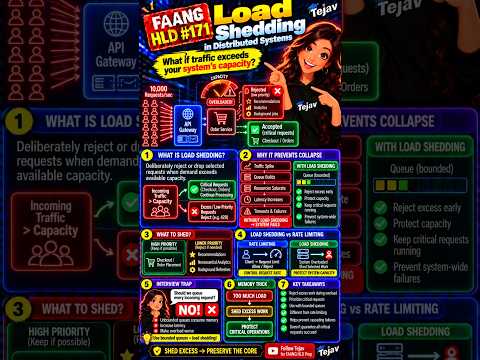
Load Shedding in Distributed Systems: Protecting Capacity
Load shedding helps systems reject excess requests to maintain performance during high demand.