
I'm preparing for
🎛️ Narrow downsubject · level · topic▾
Results · 21 for “Key-Value Stores”
← Front page✨ Smart search: matched by meaning, not just words

⚡ One HLD concept. 60 seconds. Interview ready
Dynamo-Style Databases: High-Level Design Overview
Dynamo-style databases are designed for high availability and fault tolerance in distributed systems.

⚡ One HLD concept. 60 seconds. Interview ready
Redis: Why Is It So Fast for High-Scale Systems?
Redis is a fast in-memory data store used for caching and low-latency applications.

⚡ One HLD concept. 60 seconds. Interview ready
Kafka Streams Local State: Fast Processing and Recovery
Kafka Streams uses local state for quick data access and changelogs for recovery.

⚡ One HLD concept. 60 seconds. Interview ready
B-Tree Index: Efficient Database Navigation
B-Trees help databases find data quickly without scanning every row.

⚡ One HLD concept. 60 seconds. Interview ready
Choosing a Distributed Lock: Redis vs Database vs ZooKeeper
Choosing the right distributed lock depends on your system's needs and existing tools.

⚡ One HLD concept. 60 seconds. Interview ready
Event Sourcing: Store What Happened, Rebuild the State
Event Sourcing stores every action as an event to recreate the current state.

⚡ One HLD concept. 60 seconds. Interview ready
Understanding Cassandra Partition Keys for Data Storage
Cassandra uses partition keys to determine how and where to store data across nodes.

⚡ One HLD concept. 60 seconds. Interview ready
Kafka Stateful Stream Processing: How Does It Remember?
Kafka uses state stores to remember previous events in stateful stream processing.

⚡ One HLD concept. 60 seconds. Interview ready
Time-Series Database Architecture: Storing Millions of Metrics
Time-series databases are designed to store and query time-stamped metrics efficiently.
⚡ One HLD concept. 60 seconds. Interview ready
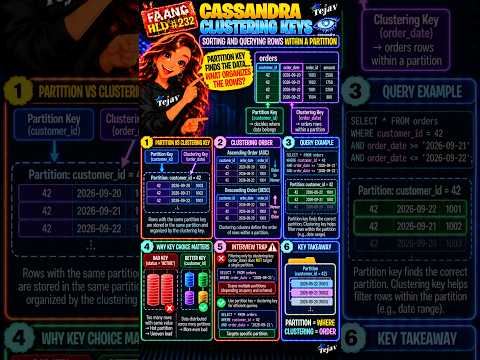
Cassandra Clustering Keys: How Rows Are Sorted
Cassandra uses clustering keys to sort rows within a partition for efficient querying.

⚡ One HLD concept. 60 seconds. Interview ready
HLD — KMS Explained 🔐 What If Your Encryption Key Gets Stolen?
KMS securely manages encryption keys to protect data from theft.

⚡ One HLD concept. 60 seconds. Interview ready
HLD: Database CDC with Kafka for Real-Time Events
CDC with Kafka allows real-time updates from databases to multiple services.

⚡ One HLD concept. 60 seconds. Interview ready
Consistent Hashing: Efficient Node Management in Distributed Systems
Consistent hashing allows efficient addition and removal of nodes with minimal key movement.

⚡ One HLD concept. 60 seconds. Interview ready
Understanding Sharding: How Databases Manage Large Data
Sharding splits databases into smaller parts to improve performance and scalability.

⚡ One HLD concept. 60 seconds. Interview ready
Consistent Hashing: Key to Distributed Systems Scalability
Consistent hashing helps distribute data across servers with minimal movement.

⚡ One HLD concept. 60 seconds. Interview ready
SQL vs NoSQL: Choosing the Right Database for Your Needs
The choice between SQL and NoSQL databases depends on your application's specific needs.

⚡ One HLD concept. 60 seconds. Interview ready
HLD: Full-Text Search vs Database Search with Elasticsearch
Choose Elasticsearch for complex text searches, but use databases for structured queries.

⚡ One HLD concept. 60 seconds. Interview ready
Token Bucket vs Leaky Bucket: Key Differences Explained
Token Bucket allows burst traffic, while Leaky Bucket smooths out traffic flow.
⚡ One HLD concept. 60 seconds. Interview ready
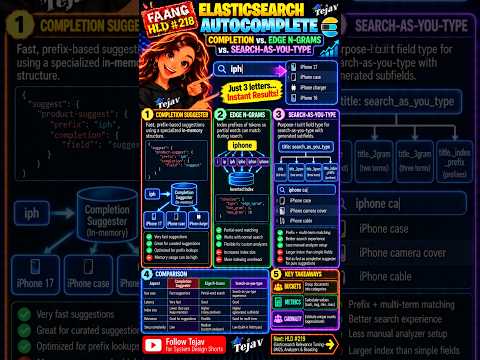
Elasticsearch Autocomplete: Completion vs. Edge N-Grams vs. Search-as-You-Type
Elasticsearch offers three main autocomplete strategies, each with unique benefits and trade-offs.

⚡ One HLD concept. 60 seconds. Interview ready
Hashing vs Encryption: Key Differences Explained
Hashing is one-way for verification, while encryption is two-way for confidentiality.

⚡ One HLD concept. 60 seconds. Interview ready
Understanding ZooKeeper Ephemeral and Sequential Nodes
ZooKeeper uses ephemeral and sequential nodes for managing distributed services effectively.