
I'm preparing for
🎛️ Narrow down IT & Codingsubject · level · topic1▾
Results · 19 for “Event Time Concepts”
← Front page✨ Smart search: matched by meaning, not just words

⚡ One HLD concept. 60 seconds. Interview ready
Understanding Event Time vs Processing Time in Stream Processing
Event time is when an event occurs, while processing time is when it is handled.

⚡ One HLD concept. 60 seconds. Interview ready
Understanding Lamport Timestamps in Distributed Systems
Lamport Timestamps help order events in distributed systems while preserving causality.

⚡ One HLD concept. 60 seconds. Interview ready
Understanding Physical vs Logical Time in Distributed Systems
Physical time tells when events happen, while logical time tells their order.

⚡ One HLD concept. 60 seconds. Interview ready
Understanding Distributed Clocks in Systems Design
In distributed systems, timestamps don't always reflect the true order of events.
⚡ One HLD concept. 60 seconds. Interview ready
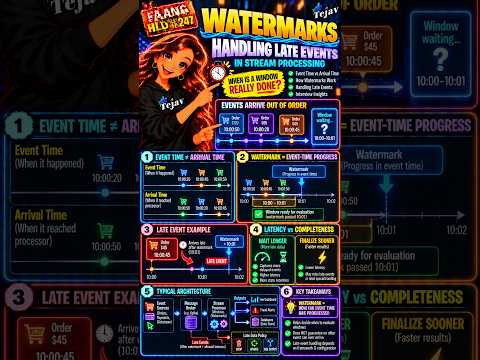
Understanding Watermarks in Stream Processing
Watermarks help stream processing systems manage event time and late events.

⚡ One HLD concept. 60 seconds. Interview ready
Understanding Causality in Distributed Systems
Causality in distributed systems helps understand how events influence each other, beyond just timestamps.

⚡ One HLD concept. 60 seconds. Interview ready
Understanding Vector Clocks in Distributed Systems
Vector clocks help track the order and concurrency of events in distributed systems.

⚡ One HLD concept. 60 seconds. Interview ready
Kafka Streams Windowing: Tumbling vs Hopping Windows Explained
Kafka Streams uses tumbling and hopping windows for time-based data aggregation.

⚡ One HLD concept. 60 seconds. Interview ready
Time-Series Data Modeling: Avoiding Cardinality Issues
Choosing the right labels in time-series data is crucial to avoid inefficiencies.

⚡ One HLD concept. 60 seconds. Interview ready
HLD: Late-Arriving Events - Drop, Update, or Replay?
Late-arriving events can be dropped, updated, or routed based on system needs.

⚡ One HLD concept. 60 seconds. Interview ready
Transactional Outbox Pattern: Never Lose Events!
The Transactional Outbox Pattern ensures database updates and event publishing are synchronized to avoid losing events.

⚡ One HLD concept. 60 seconds. Interview ready
HLD: Understanding Request-Response vs Events in System Design
Request-Response asks for a result, while Events notify that something has happened.

⚡ One HLD concept. 60 seconds. Interview ready
Time-Series Database Architecture: Storing Millions of Metrics
Time-series databases are designed to store and query time-stamped metrics efficiently.

⚡ One HLD concept. 60 seconds. Interview ready
Time-Based Partitioning: Scaling Time-Series Databases
Time-based partitioning organizes time-series data into smaller, efficient segments for better querying.
⚡ One HLD concept. 60 seconds. Interview ready
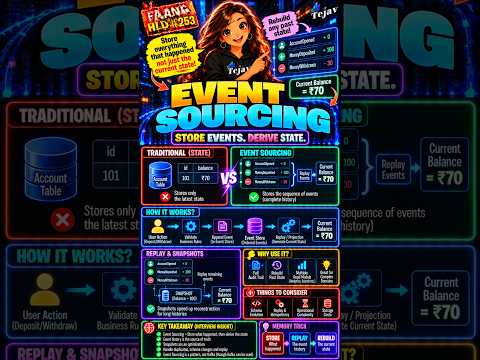
Event Sourcing: Store What Happened, Rebuild the State
Event Sourcing stores every action as an event to recreate the current state.

⚡ One HLD concept. 60 seconds. Interview ready
Tumbling vs Hopping Windows in Stream Processing
Tumbling windows are non-overlapping time segments, while hopping windows can overlap.

⚡ One HLD concept. 60 seconds. Interview ready
Stream Processing Architecture: From Events to Real-Time Insights
Stream Processing Architecture helps turn incoming events into real-time insights efficiently.

⚡ One HLD concept. 60 seconds. Interview ready
Understanding RPO and RTO in Disaster Recovery
RPO and RTO are key metrics for planning disaster recovery strategies.

⚡ One HLD concept. 60 seconds. Interview ready
Elasticsearch Data Streams vs. Time-Based Indices: Which to Choose?
Elasticsearch offers Data Streams for simplicity and Time-Based Indices for control in managing time-series data.