
I'm preparing for
🎛️ Narrow down IT & Codingsubject · level · topic▾
Results · 25 for “Virtualization principles”
← Front page✨ Smart search: matched by meaning, not just words
⚡ One HLD concept. 60 seconds. Interview ready
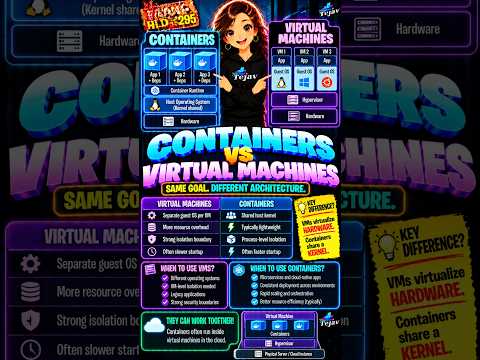
Understanding Containers vs Virtual Machines in HLD
Containers share the host OS kernel, while VMs virtualize hardware with separate OS.

⚡ One HLD concept. 60 seconds. Interview ready
Zero Trust Architecture: Never Trust, Always Verify
Zero Trust Architecture ensures that no user or device is trusted by default.

⚡ One HLD concept. 60 seconds. Interview ready
HLD: Understanding Container Storage and Data Persistence
Container data can be lost unless stored in persistent volumes.

⚡ One HLD concept. 60 seconds. Interview ready
Understanding Availability Zones in High-Level Design
Availability Zones help prevent downtime by isolating failures across multiple locations.

⚡ One HLD concept. 60 seconds. Interview ready
Container Networking: How Do Containers Communicate?
Container networking enables communication between services in different containers.

⚡ One HLD concept. 60 seconds. Interview ready
Stateless vs Stateful Servers: Scaling Made Easy
Stateless servers are easier to scale because they don't store user session data locally.

⚡ One HLD concept. 60 seconds. Interview ready
Understanding High Availability in System Design
High Availability ensures your application remains operational even during server failures.

⚡ One HLD concept. 60 seconds. Interview ready
Understanding Data Residency in High-Level Design
Data residency is crucial for compliance with laws about where data can be stored.

⚡ One HLD concept. 60 seconds. Interview ready
Understanding Fault Domains in High-Level Design
Fault domains help prevent multiple servers from failing together in an architecture.

⚡ One HLD concept. 60 seconds. Interview ready
Consistent Hashing: Efficient Node Management in Distributed Systems
Consistent hashing allows efficient addition and removal of nodes with minimal key movement.

⚡ One HLD concept. 60 seconds. Interview ready
Understanding CAP Theorem: Trade-offs in Distributed Systems
The CAP Theorem explains the trade-offs in distributed systems during network failures.

⚡ One HLD concept. 60 seconds. Interview ready
HLD: Fail Fast vs Fail Safe in System Design
Fail Fast means stopping quickly on errors, while Fail Safe ensures safety in failures.

⚡ One HLD concept. 60 seconds. Interview ready
Active-Passive Architecture: Handling Production Downtime
Active-passive architecture ensures a standby system takes over if the main system fails.

⚡ One HLD concept. 60 seconds. Interview ready
Understanding RPC: Remote Procedure Calls in Distributed Systems
RPC allows one service to call a function in another service over the network.

⚡ One HLD concept. 60 seconds. Interview ready
HLD: Single Region vs Multi-Region Architecture
Choosing between single and multi-region architecture affects system resilience and cost.

⚡ One HLD concept. 60 seconds. Interview ready
When to Use Microservices in Software Design
Microservices are useful when you need independent scaling, deployment, and clear boundaries in software design.

⚡ One HLD concept. 60 seconds. Interview ready
Disaster Recovery Across Regions: Can Your System Recover?
Disaster recovery ensures systems can restore services and data after major disruptions.

⚡ One HLD concept. 60 seconds. Interview ready
Elasticsearch Split Brain: Master Election and Quorum Explained
Elasticsearch uses master election and quorum to prevent split brain scenarios.

⚡ One HLD concept. 60 seconds. Interview ready
Consistent Hashing: Key to Distributed Systems Scalability
Consistent hashing helps distribute data across servers with minimal movement.

⚡ One HLD concept. 60 seconds. Interview ready
Understanding Network Partitions in Distributed Systems
Network partitions occur when servers are operational but can't communicate, affecting system performance.

⚡ One HLD concept. 60 seconds. Interview ready
Distributed Caching: Why Spread It Out?
Distributed caching spreads data across multiple servers for better performance and reliability.

⚡ One HLD concept. 60 seconds. Interview ready
Quorum-Based Replication: How Many Replicas Must Agree?
Quorum-based replication determines how many database replicas must agree for reads and writes.
⚡ One HLD concept. 60 seconds. Interview ready
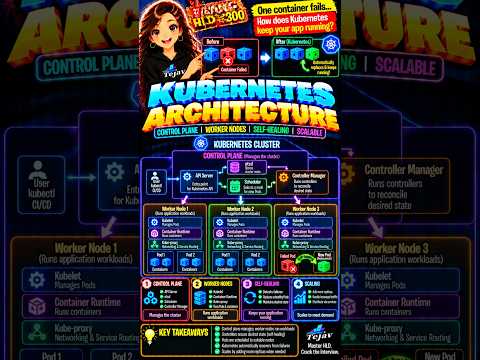
Understanding Kubernetes Architecture: Control Plane vs Worker Nodes
Kubernetes uses a Control Plane to manage Worker Nodes and ensure application reliability.

⚡ One HLD concept. 60 seconds. Interview ready
Understanding Kubernetes Pods and Deployments
Kubernetes uses Pods, ReplicaSets, and Deployments to manage application availability and updates.

⚡ One HLD concept. 60 seconds. Interview ready
Choosing Service Boundaries in Microservices Architecture
Choosing the right boundaries for microservices is crucial for effective architecture.