
I'm preparing for
🎛️ Narrow downsubject · level · topic1▾
Results · 19 for “Offset Management”
← Front page✨ Smart search: matched by meaning, not just words

⚡ One HLD concept. 60 seconds. Interview ready
Kafka Consumer Offsets: Auto Commit vs Manual Commit
Kafka consumer offsets help track message processing to avoid loss and duplication.

⚡ One HLD concept. 60 seconds. Interview ready
Transactional Outbox Pattern: Never Lose Events!
The Transactional Outbox Pattern ensures database updates and event publishing are synchronized to avoid losing events.

⚡ One HLD concept. 60 seconds. Interview ready
Kafka Async Commit Ordering: Can Older Offsets Overwrite Newer Ones?
Older offsets can overwrite newer ones in Kafka if not handled properly.

⚡ One HLD concept. 60 seconds. Interview ready
Kafka subscribe() vs assign(): Who Controls Partition Assignment?
Kafka's subscribe() lets the group manage partitions, while assign() gives control to the application.

⚡ One HLD concept. 60 seconds. Interview ready
Kafka Manual Partition Assignment: Using assign() for Control
Kafka's assign() method allows manual control of partition assignments for consumers.

⚡ One HLD concept. 60 seconds. Interview ready
Understanding Elasticsearch ILM for Cost Management
Elasticsearch ILM automates index management to reduce storage costs and meet data needs.

⚡ One HLD concept. 60 seconds. Interview ready
Optimistic vs Pessimistic Locking in Database Management
Optimistic and pessimistic locking are strategies to manage database access during concurrent transactions.

⚡ One HLD concept. 60 seconds. Interview ready
Kafka Consumer Assignment Strategies: Range vs RoundRobin vs Sticky
Kafka uses different strategies to assign partitions to consumers in a group efficiently.

⚡ One HLD concept. 60 seconds. Interview ready
Understanding Kafka Offset Reset: Earliest vs Latest
Kafka offset reset determines where a consumer starts reading messages without a valid offset.

⚡ One HLD concept. 60 seconds. Interview ready
FAANG HLD 🔥 | Kafka Seek — Replay Specific Messages Without Replaying Everything! 🎯
Kafka's `seek()` lets you replay only specific messages, saving time.

⚡ One HLD concept. 60 seconds. Interview ready
Understanding Raft Log Replication: matchIndex vs commitIndex
matchIndex tracks what each follower has, while commitIndex shows what is committed.

⚡ One HLD concept. 60 seconds. Interview ready
Kafka Commit Strategies: Auto vs Manual Commit Explained
Kafka commit strategies determine how offsets are managed during message processing.

⚡ One HLD concept. 60 seconds. Interview ready
Distributed Backpressure: Managing Service Overload
Distributed backpressure helps manage the flow of work between services to prevent overload.
⚡ One HLD concept. 60 seconds. Interview ready
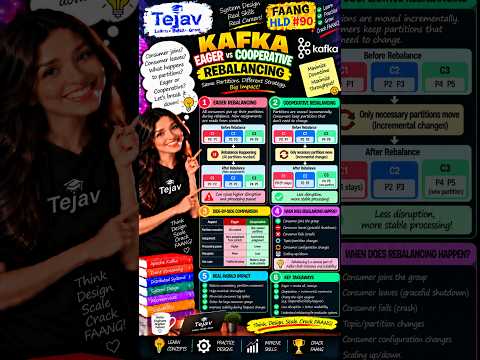
Kafka Eager vs Cooperative Rebalancing: Key Differences
Eager rebalancing revokes all assignments, while cooperative allows incremental changes.

⚡ One HLD concept. 60 seconds. Interview ready
Kafka commitSync vs commitAsync: Choosing the Right Method
Kafka's commitSync waits for confirmation, while commitAsync continues immediately.

⚡ One HLD concept. 60 seconds. Interview ready
Kafka Rebalance: Avoiding Work Loss or Duplication
Kafka rebalance can lead to lost or duplicated work if not handled carefully.

⚡ One HLD concept. 60 seconds. Interview ready
Understanding the Bulkhead Pattern in System Design
The Bulkhead Pattern isolates resources to protect critical workloads from failures.

⚡ One HLD concept. 60 seconds. Interview ready
Understanding CAP Theorem: Trade-offs in Distributed Systems
The CAP Theorem explains the trade-offs in distributed systems during network failures.

⚡ One HLD concept. 60 seconds. Interview ready
Kafka Consumer Multithreading: Processing Messages in Parallel
Kafka consumers can use multiple threads to speed up message processing, but it complicates ordering and offset management.