
I'm preparing for
Topic
system design
153 shorts across 1 course, in learning order
🎛️ Narrow downsubject · level · topic2▾
Results · 22 for “Disaster Recovery”
← Front page✨ Smart search: matched by meaning, not just words

⚡ One HLD concept. 60 seconds. Interview ready
Disaster Recovery Across Regions: Can Your System Recover?
Disaster recovery ensures systems can restore services and data after major disruptions.

⚡ One HLD concept. 60 seconds. Interview ready
Disaster Recovery Testing: Ensuring Your DR Plan Works
Disaster Recovery Testing verifies that your recovery plan works effectively in real situations.

⚡ One HLD concept. 60 seconds. Interview ready
Understanding RPO and RTO in Disaster Recovery
RPO and RTO are key metrics for planning disaster recovery strategies.

⚡ One HLD concept. 60 seconds. Interview ready
Understanding Elasticsearch Cross-Cluster Replication (CCR)
Elasticsearch CCR allows real-time data replication for faster disaster recovery.

⚡ One HLD concept. 60 seconds. Interview ready
Point-in-Time Recovery: Recovering Deleted Database Data
Point-in-Time Recovery allows databases to be restored to a specific moment before data loss.

⚡ One HLD concept. 60 seconds. Interview ready
HLD: Single Region vs Multi-Region Architecture
Choosing between single and multi-region architecture affects system resilience and cost.

⚡ One HLD concept. 60 seconds. Interview ready
Active-Passive Architecture: Handling Production Downtime
Active-passive architecture ensures a standby system takes over if the main system fails.

⚡ One HLD concept. 60 seconds. Interview ready
Understanding High Availability in System Design
High Availability ensures your application remains operational even during server failures.

⚡ One HLD concept. 60 seconds. Interview ready
Understanding Data Residency in High-Level Design
Data residency is crucial for compliance with laws about where data can be stored.

⚡ One HLD concept. 60 seconds. Interview ready
Understanding Fault Domains in High-Level Design
Fault domains help prevent multiple servers from failing together in an architecture.

⚡ One HLD concept. 60 seconds. Interview ready
HLD: Fallbacks Explained for System Design
Fallbacks allow systems to handle failures safely and maintain user experience.

⚡ One HLD concept. 60 seconds. Interview ready
Cascading Failures in Distributed Systems Explained
Cascading failures occur when one service's failure impacts others, causing widespread issues.
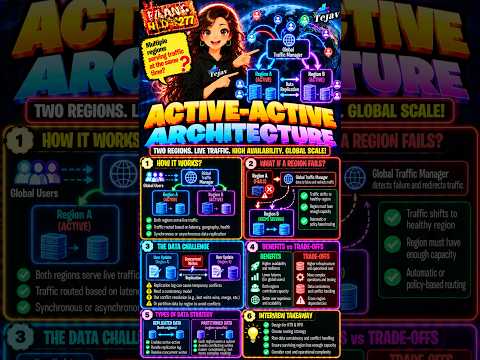
⚡ One HLD concept. 60 seconds. Interview ready
Understanding Active-Active Architecture in Distributed Systems
Active-Active Architecture uses multiple regions to serve traffic simultaneously for better resilience.

⚡ One HLD concept. 60 seconds. Interview ready
Graceful Degradation in System Design
Graceful degradation allows apps to function partially during service failures.

⚡ One HLD concept. 60 seconds. Interview ready
Understanding SPOF: Why Your App Can Go Down with Healthy Servers
A single component's failure can take down your entire application, even with redundancy.

⚡ One HLD concept. 60 seconds. Interview ready
Understanding Database Replication in High-Level Design
Database replication enhances data availability and read performance but has challenges like replication lag.

⚡ One HLD concept. 60 seconds. Interview ready
Hinted Handoff: Handling Replica Failures in Databases
Hinted Handoff allows a database to manage temporary replica failures by storing missed write operations.

⚡ One HLD concept. 60 seconds. Interview ready
HLD: Crash Failures vs Network Failures in Distributed Systems
Crash failures stop a service, while network failures disrupt communication.

⚡ One HLD concept. 60 seconds. Interview ready
Understanding Network Partitions in Distributed Systems
Network partitions occur when servers are operational but can't communicate, affecting system performance.

⚡ One HLD concept. 60 seconds. Interview ready
Understanding CAP Theorem: Trade-offs in Distributed Systems
The CAP Theorem explains the trade-offs in distributed systems during network failures.

⚡ One HLD concept. 60 seconds. Interview ready
Failover and Split-Brain in High-Level Design
Failover ensures systems remain operational by managing leader changes during failures.

⚡ One HLD concept. 60 seconds. Interview ready
Understanding Read Replicas in Database Scaling
Read replicas allow databases to handle more read requests by distributing them across multiple copies.
🧠Related by meaning
Not tagged “system design”, but closely connected

