
I'm preparing for
🎛️ Narrow downsubject · level · topic▾
Results · 25 for “Advanced Aggregation Techniques”
← Front page✨ Smart search: matched by meaning, not just words

⚡ One HLD concept. 60 seconds. Interview ready
Elasticsearch Aggregations: Buckets, Metrics, and Cardinality
Elasticsearch aggregations help analyze data by grouping, calculating, and estimating values.

⚡ One HLD concept. 60 seconds. Interview ready
Elasticsearch Aggregations: Metrics vs Buckets Explained
Elasticsearch aggregations help summarize data using metrics for calculations and buckets for grouping.

⚡ One HLD concept. 60 seconds. Interview ready
Elasticsearch Pagination: Fixing Slow Page Searches
Deep pagination in Elasticsearch can slow down searches significantly, but there are efficient methods to handle it.

⚡ One HLD concept. 60 seconds. Interview ready
Elasticsearch Pagination: From & Size vs Search After
Elasticsearch offers two pagination methods: from & size for shallow pages and search_after for deep pages.

⚡ One HLD concept. 60 seconds. Interview ready
API Pagination: Efficiently Handling Large Datasets
API pagination helps manage large datasets by breaking them into smaller parts.

⚡ One HLD concept. 60 seconds. Interview ready
Understanding Cache Breakdown and Request Coalescing
Cache breakdowns can overwhelm databases, but request coalescing solves this issue.

⚡ One HLD concept. 60 seconds. Interview ready
Kafka Consumer Fetch & Batching: Boosting Throughput
Kafka consumers can fetch data in batches to improve throughput and reduce latency.
⚡ One HLD concept. 60 seconds. Interview ready
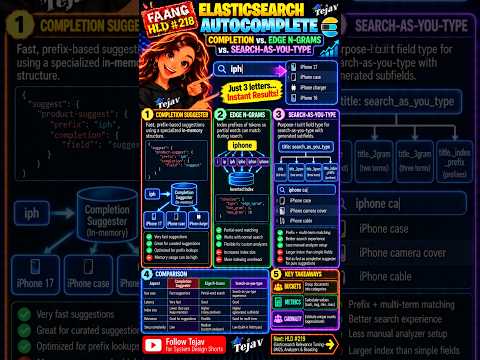
Elasticsearch Autocomplete: Completion vs. Edge N-Grams vs. Search-as-You-Type
Elasticsearch offers three main autocomplete strategies, each with unique benefits and trade-offs.

⚡ One HLD concept. 60 seconds. Interview ready
Understanding the Cache-Aside Pattern in System Design
The Cache-Aside Pattern speeds up data retrieval by using a cache to store frequently accessed data.

⚡ One HLD concept. 60 seconds. Interview ready
Elasticsearch Query Optimization: Filters and Caching
Optimizing Elasticsearch involves using filters, caching, and measuring performance.

⚡ One HLD concept. 60 seconds. Interview ready
Kafka Async Commit Ordering: Can Older Offsets Overwrite Newer Ones?
Older offsets can overwrite newer ones in Kafka if not handled properly.

⚡ One HLD concept. 60 seconds. Interview ready
FAANG HLD 🔥 | Kafka Seek — Replay Specific Messages Without Replaying Everything! 🎯
Kafka's `seek()` lets you replay only specific messages, saving time.

⚡ One HLD concept. 60 seconds. Interview ready
Composite Indexes: Speed Up Multi-Column Queries in Databases
Composite indexes speed up database queries that filter or sort by multiple columns.

⚡ One HLD concept. 60 seconds. Interview ready
FAANG HLD 🔥 | Partition Pruning Explained — Scan Less, Query Faster! ⚡
Partition pruning helps databases skip unnecessary data scans, speeding up queries.

⚡ One HLD concept. 60 seconds. Interview ready
Distributed Caching: Why Spread It Out?
Distributed caching spreads data across multiple servers for better performance and reliability.

⚡ One HLD concept. 60 seconds. Interview ready
Kafka Streams Windowing: Tumbling vs Hopping Windows Explained
Kafka Streams uses tumbling and hopping windows for time-based data aggregation.

⚡ One HLD concept. 60 seconds. Interview ready
Understanding Scalable System Design in FAANG Companies
FAANG engineers use high-level design principles to create scalable systems.

⚡ One HLD concept. 60 seconds. Interview ready
HLD: Search Engine Architecture and Its Components
Search engines collect, index, retrieve, and rank documents to provide relevant results.

⚡ One HLD concept. 60 seconds. Interview ready
Understanding Sharding: How Databases Manage Large Data
Sharding splits databases into smaller parts to improve performance and scalability.

⚡ One HLD concept. 60 seconds. Interview ready
Kafka Stateful Stream Processing: How Does It Remember?
Kafka uses state stores to remember previous events in stateful stream processing.

⚡ One HLD concept. 60 seconds. Interview ready
Kafka Streams vs Consumer: Choosing the Right Tool
Kafka Streams offers higher-level abstractions, while Kafka Consumer provides direct control.

⚡ One HLD concept. 60 seconds. Interview ready
Understanding Vertical and Horizontal Scaling in System Design
Vertical scaling means upgrading one server, while horizontal scaling means adding more servers.

⚡ One HLD concept. 60 seconds. Interview ready
Kafka commitSync vs commitAsync: Choosing the Right Method
Kafka's commitSync waits for confirmation, while commitAsync continues immediately.

⚡ One HLD concept. 60 seconds. Interview ready
FAANG HLD 🔥 | Kafka Backpressure Explained — What Happens When Consumers Can't Keep Up? 🚨
Backpressure prevents system overload by managing message processing rates in Kafka.
⚡ One HLD concept. 60 seconds. Interview ready
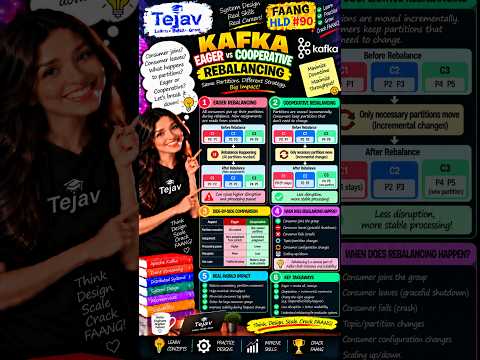
Kafka Eager vs Cooperative Rebalancing: Key Differences
Eager rebalancing revokes all assignments, while cooperative allows incremental changes.