
I'm preparing for
🎛️ Narrow downsubject · level · topic▾
Results · 8 for “Event Time Management”
← Front page✨ Smart search: matched by meaning, not just words

⚡ One HLD concept. 60 seconds. Interview ready
Transactional Outbox Pattern: Never Lose Events!
The Transactional Outbox Pattern ensures database updates and event publishing are synchronized to avoid losing events.

⚡ One HLD concept. 60 seconds. Interview ready
HLD: Late-Arriving Events - Drop, Update, or Replay?
Late-arriving events can be dropped, updated, or routed based on system needs.
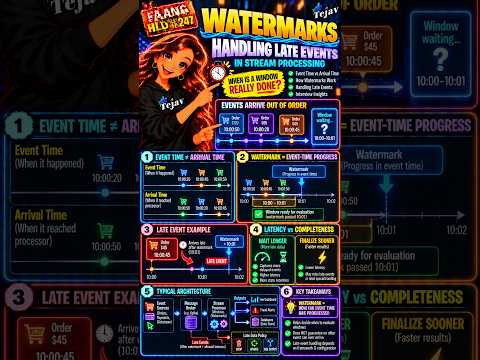
⚡ One HLD concept. 60 seconds. Interview ready
Understanding Watermarks in Stream Processing
Watermarks help stream processing systems manage event time and late events.

⚡ One HLD concept. 60 seconds. Interview ready
Understanding Distributed Clocks in Systems Design
In distributed systems, timestamps don't always reflect the true order of events.

⚡ One HLD concept. 60 seconds. Interview ready
Understanding Lamport Timestamps in Distributed Systems
Lamport Timestamps help order events in distributed systems while preserving causality.

⚡ One HLD concept. 60 seconds. Interview ready
Understanding Physical vs Logical Time in Distributed Systems
Physical time tells when events happen, while logical time tells their order.

⚡ One HLD concept. 60 seconds. Interview ready
Kafka Streams Windowing: Tumbling vs Hopping Windows Explained
Kafka Streams uses tumbling and hopping windows for time-based data aggregation.

⚡ One HLD concept. 60 seconds. Interview ready
Time-Based Partitioning: Scaling Time-Series Databases
Time-based partitioning organizes time-series data into smaller, efficient segments for better querying.