
I'm preparing for
🎛️ Narrow downsubject · level · topic▾
Results · 27 for “Data structures knowledge”
← Front page✨ Smart search: matched by meaning, not just words

⚡ One HLD concept. 60 seconds. Interview ready
B-Tree Index: Efficient Database Navigation
B-Trees help databases find data quickly without scanning every row.

⚡ One HLD concept. 60 seconds. Interview ready
Understanding Sharding: How Databases Manage Large Data
Sharding splits databases into smaller parts to improve performance and scalability.

⚡ One HLD concept. 60 seconds. Interview ready
SQL vs NoSQL: Choosing the Right Database for Your Needs
The choice between SQL and NoSQL databases depends on your application's specific needs.

⚡ One HLD concept. 60 seconds. Interview ready
Database Indexing: How to Make Queries Fast
Database indexing speeds up data retrieval by allowing quick lookups.

⚡ One HLD concept. 60 seconds. Interview ready
Understanding Database per Service in Microservices Architecture
Database per Service ensures each microservice owns its data, reducing dependencies.

⚡ One HLD concept. 60 seconds. Interview ready
Protobuf and Schema Evolution: Avoid Breaking Changes
Protobuf schema evolution requires careful changes to avoid breaking existing clients.

⚡ One HLD concept. 60 seconds. Interview ready
Redis: Why Is It So Fast for High-Scale Systems?
Redis is a fast in-memory data store used for caching and low-latency applications.

⚡ One HLD concept. 60 seconds. Interview ready
Understanding High-Level Design (HLD) and Low-Level Design (LLD)
HLD provides an overview of system architecture, while LLD details implementation specifics.

⚡ One HLD concept. 60 seconds. Interview ready
HLD: Search Engine Architecture and Its Components
Search engines collect, index, retrieve, and rank documents to provide relevant results.

⚡ One HLD concept. 60 seconds. Interview ready
Structured Logging: Debugging Production Issues Faster
Structured logging helps in quickly identifying issues by organizing log data consistently.

⚡ One HLD concept. 60 seconds. Interview ready
Elasticsearch Mapping: Dynamic vs Explicit Explained
Elasticsearch mapping defines how fields are indexed and searched, with dynamic and explicit options.

⚡ One HLD concept. 60 seconds. Interview ready
Understanding Scalable System Design in FAANG Companies
FAANG engineers use high-level design principles to create scalable systems.

⚡ One HLD concept. 60 seconds. Interview ready
Understanding Elasticsearch Data Streams in HLD
Elasticsearch Data Streams simplify time-series data management with one name for many indices.

⚡ One HLD concept. 60 seconds. Interview ready
HLD: Full-Text Search vs Database Search with Elasticsearch
Choose Elasticsearch for complex text searches, but use databases for structured queries.

⚡ One HLD concept. 60 seconds. Interview ready
Kafka Schema Evolution: Changing Schemas Without Breaking Consumers
Kafka Schema Evolution allows safe changes to message structures without breaking existing consumers.

⚡ One HLD concept. 60 seconds. Interview ready
Understanding Physical vs Logical Time in Distributed Systems
Physical time tells when events happen, while logical time tells their order.

⚡ One HLD concept. 60 seconds. Interview ready
Elasticsearch Aggregations: Buckets, Metrics, and Cardinality
Elasticsearch aggregations help analyze data by grouping, calculating, and estimating values.

⚡ One HLD concept. 60 seconds. Interview ready
Kafka Stateful Stream Processing: How Does It Remember?
Kafka uses state stores to remember previous events in stateful stream processing.

⚡ One HLD concept. 60 seconds. Interview ready
Understanding Transactions and ACID Properties in Databases
Transactions ensure database operations are reliable using ACID properties.
⚡ One HLD concept. 60 seconds. Interview ready
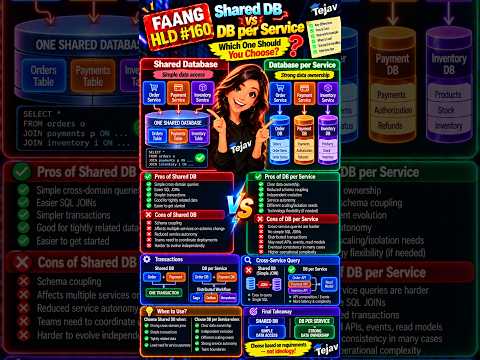
HLD: Shared DB vs Database per Service Trade-Offs
Choosing between a shared database and a database per service affects system design significantly.

⚡ One HLD concept. 60 seconds. Interview ready
Elasticsearch Data Streams vs. Time-Based Indices: Which to Choose?
Elasticsearch offers Data Streams for simplicity and Time-Based Indices for control in managing time-series data.

⚡ One HLD concept. 60 seconds. Interview ready
Kafka Retention vs Compaction: History or Latest State?
Kafka uses retention to keep historical data and compaction to keep the latest state.

⚡ One HLD concept. 60 seconds. Interview ready
Understanding the Cache-Aside Pattern in System Design
The Cache-Aside Pattern speeds up data retrieval by using a cache to store frequently accessed data.

⚡ One HLD concept. 60 seconds. Interview ready
Understanding Consistency Models in Distributed Systems
Consistency models determine what data reads in distributed systems can see.

⚡ One HLD concept. 60 seconds. Interview ready
Consistent Hashing: Key to Distributed Systems Scalability
Consistent hashing helps distribute data across servers with minimal movement.

⚡ One HLD concept. 60 seconds. Interview ready
Understanding Cache Hits: Reducing Database Load
Caching helps applications respond faster by serving data from memory instead of hitting the database.

⚡ One HLD concept. 60 seconds. Interview ready
Distributed Caching: Why Spread It Out?
Distributed caching spreads data across multiple servers for better performance and reliability.