
QuestionWhat are the implications of using a shared database in microservices?
Understanding Database per Service in Microservices Architecture
- medium level
- 60-sec video
- 5-min read
- 5-question quiz
The big idea
Database per Service ensures each microservice owns its data, reducing dependencies.
Your path
Log in to save progress
Explain it like I’m 10
Imagine each toy box is a microservice. If one box shares toys with another, changing a toy in one box can mess up the other. If each box has its own toys, they can change freely without problems.
Introduction
In microservices architecture, the Database per Service pattern is crucial for maintaining autonomy and reducing coupling between services. This concept ensures that each microservice owns its data, which is essential for independent development and deployment.
The Shared Database Problem
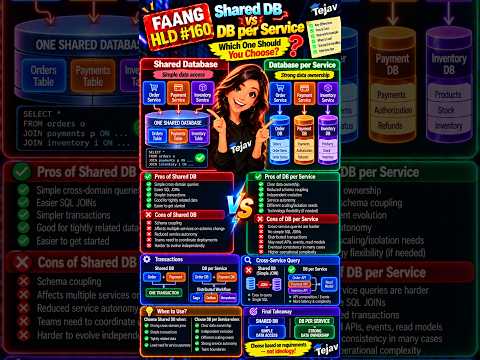
- When multiple services (like Order, Payment, and Inventory) share the same database schema, changes in one service can impact others.
- This leads to schema-level coupling, making it difficult to evolve services independently.
What Is Database per Service?
- Each microservice should own its domain data, controlling access to its own persistence layer.
- Examples:
- Order Service → Owns Order Data
- Payment Service → Owns Payment Data
- Inventory Service → Owns Inventory Data
- Note: Owning data does not necessarily mean a separate physical database server is required. Logical separation (schemas) can also be effective.
How Do Services Share Data?
- Services should not directly access each other's databases. Instead, they can communicate through:
- APIs: Requesting data or invoking actions.
- Events: Publishing events like
OrderCreatedorPaymentCompleted. - Read Models: Creating query-friendly views for data needed from multiple services.
Benefits of Database per Service
- Clearer Data Ownership: Each service knows its data.
- Reduced Schema-Level Coupling: Changes in one service do not affect others.
- Greater Service Autonomy: Services can evolve independently.
- Independent Evolution of Persistence: Each service can choose its database technology if needed.
Trade-Offs
- Cross-service queries become complex. Instead of a simple SQL JOIN, you might need API composition or dedicated read models.
- Business operations that span multiple services may require distributed workflows, leading to complexities in consistency. Patterns like Saga or Transactional Outbox can help manage these complexities.
Conclusion
In system design interviews, it’s important to explain not just the concept of Database per Service, but also the data ownership, access, and inter-service communication strategies. This demonstrates a deeper understanding of microservices architecture.
Where you’ll see this
This concept is applied in companies like Flipkart and Zomato, where different services manage their own data independently.
How exams test this
Exams may ask about the advantages and challenges of Database per Service; a common trap is misunderstanding data ownership.
📖 Words to know
- Microservices
- An architectural style that structures an application as a collection of loosely coupled services.
- Schema-Level Coupling
- Dependency between services due to shared database schema.
- Saga
- A pattern for managing distributed transactions across multiple services.
Got it? Lock it in 🔒
5 quick questions. Students who test themselves remember far more than those who just re-read.
30-second revision card
- 1Each service should own its domain data.
- 2Avoid schema-level coupling to enhance independence.
- 3Services communicate via APIs, events, and read models.
- 4Consider trade-offs like complex cross-service queries.
- 5Use patterns like Saga for distributed transactions.
Memory trick
Own your data, own your service.
🧠 Recall check
Answer in your head, then tap to flip. Recalling beats re-reading.
Myth vs Fact
❌ Myth: Every service needs a separate physical database.
✅ Fact: Services can share logical databases or schemas.
❌ Myth: Database per Service eliminates all coupling.
✅ Fact: It reduces coupling but does not eliminate it.
Ready to prove it? 🎯
You’ve revised the essentials. See how much actually stuck.
Question 1 of 5
Log in to take the quiz and lock this concept in
- 🎯Instant answers & explanationsSee why each answer is right, and the trap in the wrong ones.
- 📍Continue where you left offYour progress follows you on every device.
- 🧠Smart revision remindersTopics come back after 1 → 3 → 7 → 21 → 60 days, right before you’d forget.
- 🔥Streaks & activity heatmapBuild a daily habit, one short at a time.
- 📊Your weak spots, found for youSee which concepts need work and practise just those.
- 🔖Save topics for laterBookmark shorts to revisit before exams.
No credit card. Watching and reading stay free without an account.
Learn next
Watch first
Course outline · 220 topics
- 1What FAANG Interviewers Evaluate in System Design Interviews
- 2Understanding High-Level Design (HLD) and Low-Level Design (LLD)
- 3Understanding Functional and Non-Functional Requirements
- 4Understanding Scalable System Design in FAANG Companies
- 5Understanding Latency, Throughput, and Response Time
- 6Understanding Availability vs Reliability in System Design
- 7Understanding Latency and Throughput in System Design
- 8Understanding Vertical and Horizontal Scaling in System Design
- 9Stateless vs Stateful Servers: Scaling Made Easy
- 10Monolith vs Microservices: Choosing the Right Architecture
- 11Understanding Load Balancers in System Design
- 12L4 vs L7 Load Balancers: Key Differences Explained
- 13Understanding Reverse Proxy in High-Level Design
- 14Understanding CDN: How Cache Hits Improve Performance
- 15Understanding Cache Hits: Reducing Database Load
- 16Understanding the Cache-Aside Pattern in System Design
- 17Redis: Why Is It So Fast for High-Scale Systems?
- 18SQL vs NoSQL: Choosing the Right Database for Your Needs
- 19Understanding Database Replication in High-Level Design
- 20Understanding Sharding: How Databases Manage Large Data
- 21FAANG HLD 🔥 | Partition Pruning Explained — Scan Less, Query Faster! ⚡
- 22B-Tree Index: Efficient Database Navigation
- 23Read-After-Write Consistency in Database Systems
- 24Understanding Read Replicas in Database Scaling
- 25Identifying and Optimizing Database Bottlenecks
- 26Understanding CAP Theorem: Trade-offs in Distributed Systems
- 27Understanding Consistency Models in Distributed Systems
- 28Understanding Quorum Reads in Distributed Systems
- 29Leader Election in Distributed Systems: Handling Leader Failures
- 30Log Replication and Majority Commit in Distributed Systems
- 31Consistent Hashing: Key to Distributed Systems Scalability
- 32Distributed Caching: Why Spread It Out?
- 33Cache Eviction Policies: LRU, LFU, and FIFO Explained
- 34Cache Invalidation: TTL vs Freshness Explained
- 35Understanding Cache Stampede in High-Level Design
- 36Understanding Cache Penetration in System Design
- 37Understanding Cache Breakdown and Request Coalescing
- 38Token Bucket Rate Limiting Explained for Interviews
- 39Token Bucket vs Leaky Bucket: Key Differences Explained
- 40API Gateway: The Front Door of Your System
- 41API Gateway vs Proxy vs Load Balancer: Key Differences
- 42Service Discovery in Microservices Architecture
- 43DNS Service Discovery: Is DNS Enough for Microservices?
- 44Understanding DNS Record Types: A, CNAME, MX, and More
- 45Understanding DNS Resolution: How URLs Load in Browsers
- 46Understanding TCP 3-Way Handshake: SYN, SYN-ACK, ACK
- 47Understanding the TLS Handshake in HTTPS Connections
- 48HTTP vs HTTPS: Understanding the Key Differences
- 49Understanding HTTP Methods and Status Codes
- 50REST API Design: Building Scalable APIs for Real-World Use
- 51API Pagination: Efficiently Handling Large Datasets
- 52Database Indexing: How to Make Queries Fast
- 53Composite Indexes: Speed Up Multi-Column Queries in Databases
- 54Read vs Write Scaling: How to Scale Databases
- 55Database Replication: Scale and Survive Failures
- 56Sync vs Async Replication: Choosing the Right Approach
- 57Failover and Split-Brain in High-Level Design
- 58Understanding Write-Ahead Log (WAL) in Databases
- 59Understanding Transactions and ACID Properties in Databases
- 60Understanding Database Isolation Levels in Software Engineering
- 61Optimistic vs Pessimistic Locking in Database Management
- 62Understanding 2-Phase Commit in Distributed Transactions
- 63Understanding the Saga Pattern in Distributed Transactions
- 64Transactional Outbox Pattern: Never Lose Events!
- 65Understanding Idempotency in System Design
- 66Understanding Message Queues in Distributed Systems
- 67Queue vs Pub/Sub: Key Differences in System Design
- 68Understanding Apache Kafka for Scalable Event Streaming
- 69Understanding Kafka Partitioning for Scalable Messaging
- 70Message Delivery Semantics: At-Most-Once vs At-Least-Once vs Exactly-Once
- 71Understanding Kafka Consumer Lag and Its Impact
- 72Kafka Retention vs Compaction: History or Latest State?
- 73Kafka Exactly-Once Processing: Avoiding Duplicates
- 74Kafka Schema Evolution: Changing Schemas Without Breaking Consumers
- 75Kafka Producer Reliability: ACKs, Retries & Idempotence
- 76Kafka Ordering and Keys: Ensuring Message Order
- 77Kafka Consumer Offsets: Auto Commit vs Manual Commit
- 78Understanding Kafka Retries and Dead Letter Queue (DLQ)
- 79FAANG HLD 🔥 | Kafka Backpressure Explained — What Happens When Consumers Can't Keep Up? 🚨
- 80Understanding Kafka Brokers, Controllers, and KRaft Architecture
- 81Kafka Replication and ISR: Ensuring Data Availability
- 82Kafka Partition Reassignment: Move Replicas Without Data Loss
- 83Kafka Consumer Group Rebalancing Explained
- 84Kafka Consumer Assignment Strategies: Range vs RoundRobin vs Sticky
- 85Kafka Consumer Liveness: Heartbeats, Sessions & Timeouts Explained
- 86Kafka Consumer Lag Monitoring: Prevent Production Issues
- 87Kafka Lag Recovery Time: How Fast Can Consumers Catch Up?
- 88Kafka Consumer Fetch & Batching: Boosting Throughput
- 89Kafka Fetch Limits vs Poll Records: Understanding the Difference
- 90Kafka Eager vs Cooperative Rebalancing: Key Differences
- 91Kafka Static Membership: Reducing Unnecessary Rebalancing
- 92Understanding Kafka Rebalance Listeners in High-Level Design
- 93Understanding Kafka Offset Reset: Earliest vs Latest
- 94Kafka Replay Safely: Reprocess Messages Without Losing Data
- 95Kafka Commit Strategies: Auto vs Manual Commit Explained
- 96Kafka commitSync vs commitAsync: Choosing the Right Method
- 97Kafka Async Commit Ordering: Can Older Offsets Overwrite Newer Ones?
- 98Kafka Consumer Concurrency: Understanding Partitions and Threads
- 99Kafka Consumer Multithreading: Processing Messages in Parallel
- 100Kafka Consumer Parallelism: Partitions, Keys, and Throughput
- 101Kafka Consumer Pause & Resume: Managing Backpressure Smartly
- 102Kafka Backpressure Strategies: Handling Traffic Spikes
- 103Kafka Graceful Shutdown: Stop Without Losing Work
- 104Kafka Error Handling and Retry Strategies in HLD
- 105Kafka Retry Topics and Delayed Retries Explained
- 106Understanding Kafka Dead Letter Topics and Poison Messages
- 107Kafka Poison Messages: Risks of Infinite Retries
- 108Kafka Consumer Reprocessing: Safe Event Replay Strategies
- 109Kafka Replay Without Breaking Production: Safe Architecture
- 110Kafka Pause vs Seek: Key Differences Explained
- 111FAANG HLD 🔥 | Kafka Seek — Replay Specific Messages Without Replaying Everything! 🎯
- 112Kafka subscribe() vs assign(): Who Controls Partition Assignment?
- 113Kafka Manual Partition Assignment: Using assign() for Control
- 114Kafka Rebalance: Avoiding Work Loss or Duplication
- 115Kafka Consumer Crash Recovery: Resuming Processing Explained
- 116Kafka Consumer State: Position, Offset, and Business State
- 117Kafka Stateful Stream Processing: How Does It Remember?
- 118Kafka Streams vs Consumer: Choosing the Right Tool
- 119Kafka Streams Local State: Fast Processing and Recovery
- 120Kafka Streams Windowing: Tumbling vs Hopping Windows Explained
- 121Distributed Locks: Preventing Duplicate Work Across Servers
- 122Choosing a Distributed Lock: Redis vs Database vs ZooKeeper
- 123Leader Election in Distributed Systems Explained
- 124Leader Election Algorithms: Bully vs Raft vs ZooKeeper
- 125Understanding Consensus in Distributed Systems
- 126Understanding Raft Consensus: Terms, Elections & Log Replication
- 127Understanding Raft Log Replication: matchIndex vs commitIndex
- 128Raft Leader Failure and Re-election Process Explained
- 129FAANG HLD 🔥 | Raft Safety — Why Committed Entries Survive Leader Failure! 🛡️
- 130Understanding Quorum and Majority in Distributed Systems
- 131Paxos Consensus: Understanding Distributed Agreement
- 132FAANG HLD 🔥 | Raft vs Paxos — What's the Difference? Consensus Explained! ⚡
- 133ZooKeeper Architecture and ZAB Explained
- 134Understanding ZooKeeper Ephemeral and Sequential Nodes
- 135ZooKeeper Watches: Avoiding the Thundering Herd Problem
- 136HLD: Crash Failures vs Network Failures in Distributed Systems
- 137HLD: Fail-Stop vs Fail-Recover Explained
- 138Understanding Network Partitions in Distributed Systems
- 139Understanding Partial Failure in Distributed Systems
- 140HLD: Understanding Server Failure Detection and Timeouts
- 141Understanding Distributed Clocks in Systems Design
- 142Understanding Physical vs Logical Time in Distributed Systems
- 143Understanding Lamport Timestamps in Distributed Systems
- 144Understanding Vector Clocks in Distributed Systems
- 145Understanding Causality in Distributed Systems
- 146Understanding RPC: Remote Procedure Calls in Distributed Systems
- 147HLD: Understanding REST, RPC, and gRPC Differences
- 148Understanding gRPC Architecture: Behind the Call
- 149Protobuf and Schema Evolution: Avoid Breaking Changes
- 150Understanding Unary vs Streaming RPC in gRPC
- 151HLD: Synchronous vs Asynchronous Communication Explained
- 152HLD: Understanding Request-Response vs Events in System Design
- 153HLD: 5 Microservices Communication Patterns Explained
- 154Connection Pooling Explained: Why a Bigger Pool Can Hurt
- 155Keep-Alive in Networking: Efficient HTTP Connections
- 156When to Use Microservices in Software Design
- 157HLD: Microservices vs Modular Monolith Explained
- 158Choosing Service Boundaries in Microservices Architecture
- 159Understanding Database per Service in Microservices Architecture
- 160HLD: Shared DB vs Database per Service Trade-Offs
- 161HLD: Circuit Breaker Explained to Prevent Failures
- 162Understanding the Retry Pattern in System Design
- 163HLD Timeout Pattern: Understanding Timeouts in Distributed Systems
- 164Understanding the Bulkhead Pattern in System Design
- 165HLD: Fallbacks Explained for System Design
- 166Understanding Retry Storms in Distributed Systems
- 167Exponential Backoff: Managing Retry Storms in Systems
- 168Understanding Jitter in High-Level Design
- 169Understanding Circuit Breaker: CLOSED, OPEN, and HALF-OPEN States
- 170Cascading Failures in Distributed Systems Explained
- 171Load Shedding in Distributed Systems: Protecting Capacity
- 172Graceful Degradation in System Design
- 173Distributed Backpressure: Managing Service Overload
- 174HLD: Fail Fast vs Fail Safe in System Design
- 175HLD: Managing Dependency Failures in Distributed Systems
- 176Understanding Logs, Metrics, and Traces in Software Engineering
- 177Observability in Distributed Systems: Debugging Production Issues
- 178Structured Logging: Debugging Production Issues Faster
- 179Understanding Correlation IDs in Microservices Architecture
- 180Understanding Distributed Tracing in Microservices Architecture
- 181Understanding the RED Method for Microservices Monitoring
- 182Understanding the USE Method for Infrastructure Bottlenecks
- 183Understanding SLIs, SLOs, and SLAs in Reliability Engineering
- 184Understanding Error Budgets in High-Level Design
- 185Understanding Alerting in High-Level Design
- 186HLD: Search Engine Architecture and Its Components
- 187Inverted Index: How Search Engines Find Pages Efficiently
- 188HLD: Tokenization and Analyzers in Search Engines
- 189HLD: Stemming and Normalization in Search Engines
- 190HLD: Full-Text Search vs Database Search with Elasticsearch
- 191Elasticsearch Architecture: How Distributed Search Works
- 192Elasticsearch Shards vs Replicas: Partitioning vs Duplication
- 193Elasticsearch Indexing: Why Can't You Search Your Document Yet?
- 194Elasticsearch Query Execution: How Searches Work Across Shards
- 195Elasticsearch Refresh: Why Your Document Isn’t Searchable Yet
- 196Understanding Elasticsearch Relevance Scoring with BM25
- 197Elasticsearch Filters vs Queries: MUST vs FILTER Explained
- 198Elasticsearch Aggregations: Metrics vs Buckets Explained
- 199Elasticsearch Pagination: From & Size vs Search After
- 200Understanding Elasticsearch ILM: Hot, Warm, Cold Phases
- 201Elasticsearch Aliases and Rollover: Zero-Downtime Index Switching
- 202Understanding Elasticsearch Data Streams in HLD
- 203Understanding Elasticsearch Index Templates and Components
- 204Elasticsearch Mapping: Dynamic vs Explicit Explained
- 205Understanding Elasticsearch Shards and Replicas in HLD
- 206Elasticsearch Cluster Sizing: How Many Nodes Do You Need?
- 207Understanding Elasticsearch Node Roles for Scaling Clusters
- 208Elasticsearch Split Brain: Master Election and Quorum Explained
- 209Understanding Elasticsearch Snapshots: Replicas vs Backups
- 210Understanding Elasticsearch Cross-Cluster Replication (CCR)
- 211Understanding Elasticsearch ILM for Cost Management
- 212Elasticsearch Data Streams vs. Time-Based Indices: Which to Choose?
- 213Elasticsearch Zero-Downtime Reindexing: The Alias Switch Trick
- 214Elasticsearch Reindexing: Understanding the Dual-Write Trap
- 215Elasticsearch Query Optimization: Filters and Caching
- 216Elasticsearch Pagination: Fixing Slow Page Searches
- 217Elasticsearch Aggregations: Buckets, Metrics, and Cardinality
- 218Elasticsearch Autocomplete: Completion vs. Edge N-Grams vs. Search-as-You-Type
- 219Elasticsearch Fuzzy Search: Handling Typos in Queries
- 220Understanding Elasticsearch Synonyms and Analyzers
Connected concepts
⚡ One HLD concept. 60 seconds. Interview ready
HLD: Shared DB vs Database per Service Trade-Offs
Choosing between a shared database and a database per service affects system design significantly.

⚡ One HLD concept. 60 seconds. Interview ready
Choosing Service Boundaries in Microservices Architecture
Choosing the right boundaries for microservices is crucial for effective architecture.

⚡ One HLD concept. 60 seconds. Interview ready
When to Use Microservices in Software Design
Microservices are useful when you need independent scaling, deployment, and clear boundaries in software design.

⚡ One HLD concept. 60 seconds. Interview ready
Understanding the Saga Pattern in Distributed Transactions
The Saga Pattern manages distributed transactions using local transactions and compensating actions.

⚡ One HLD concept. 60 seconds. Interview ready
Understanding Sharding: How Databases Manage Large Data
Sharding splits databases into smaller parts to improve performance and scalability.

⚡ One HLD concept. 60 seconds. Interview ready
DNS Service Discovery: Is DNS Enough for Microservices?
DNS helps microservices find each other, but it has limitations that may require a service registry.