
I'm preparing for
🎛️ Narrow down IT & Codingsubject · level · topic1▾
Results · 56
← Front page
⚡ One HLD concept. 60 seconds. Interview ready
Elasticsearch Split Brain: Master Election and Quorum Explained
Elasticsearch uses master election and quorum to prevent split brain scenarios.

⚡ One HLD concept. 60 seconds. Interview ready
Understanding gRPC Architecture: Behind the Call
gRPC allows efficient communication between services using a structured request-response model.

⚡ One HLD concept. 60 seconds. Interview ready
Understanding RPC: Remote Procedure Calls in Distributed Systems
RPC allows one service to call a function in another service over the network.

⚡ One HLD concept. 60 seconds. Interview ready
Understanding Causality in Distributed Systems
Causality in distributed systems helps understand how events influence each other, beyond just timestamps.

⚡ One HLD concept. 60 seconds. Interview ready
Understanding Physical vs Logical Time in Distributed Systems
Physical time tells when events happen, while logical time tells their order.

⚡ One HLD concept. 60 seconds. Interview ready
Understanding Network Partitions in Distributed Systems
Network partitions occur when servers are operational but can't communicate, affecting system performance.

⚡ One HLD concept. 60 seconds. Interview ready
ZooKeeper Watches: Avoiding the Thundering Herd Problem
ZooKeeper watches notify clients of changes, avoiding constant polling and reducing server load.

⚡ One HLD concept. 60 seconds. Interview ready
HLD: Crash Failures vs Network Failures in Distributed Systems
Crash failures stop a service, while network failures disrupt communication.
⚡ One HLD concept. 60 seconds. Interview ready
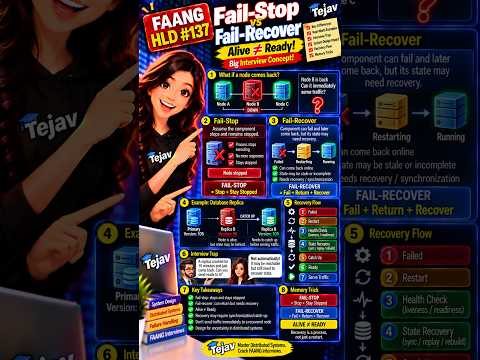
HLD: Fail-Stop vs Fail-Recover Explained
Fail-stop means a system stops and stays down, while fail-recover means it can come back but needs to be ready.

⚡ One HLD concept. 60 seconds. Interview ready
Understanding ZooKeeper Ephemeral and Sequential Nodes
ZooKeeper uses ephemeral and sequential nodes for managing distributed services effectively.

⚡ One HLD concept. 60 seconds. Interview ready
FAANG HLD 🔥 | Raft vs Paxos — What's the Difference? Consensus Explained! ⚡
Raft and Paxos are protocols that help computers agree on values in distributed systems.

⚡ One HLD concept. 60 seconds. Interview ready
Paxos Consensus: Understanding Distributed Agreement
Paxos is a protocol that helps distributed systems agree on one value despite failures.

⚡ One HLD concept. 60 seconds. Interview ready
Understanding Quorum and Majority in Distributed Systems
Quorum and majority help distributed systems maintain data consistency and availability.

⚡ One HLD concept. 60 seconds. Interview ready
FAANG HLD 🔥 | Raft Safety — Why Committed Entries Survive Leader Failure! 🛡️
Raft's safety rules guarantee that committed entries are preserved even after leader failures.

⚡ One HLD concept. 60 seconds. Interview ready
Raft Leader Failure and Re-election Process Explained
Raft handles leader failure by allowing followers to elect a new leader through voting.

⚡ One HLD concept. 60 seconds. Interview ready
Understanding Raft Consensus: Terms, Elections & Log Replication
Raft consensus helps distributed systems elect leaders and replicate logs reliably.

⚡ One HLD concept. 60 seconds. Interview ready
Understanding Raft Log Replication: matchIndex vs commitIndex
matchIndex tracks what each follower has, while commitIndex shows what is committed.

⚡ One HLD concept. 60 seconds. Interview ready
Leader Election in Distributed Systems Explained
Leader election helps distributed systems select one coordinator from many nodes.

⚡ One HLD concept. 60 seconds. Interview ready
Leader Election Algorithms: Bully vs Raft vs ZooKeeper
Bully, Raft, and ZooKeeper are distinct algorithms for leader election in distributed systems.

⚡ One HLD concept. 60 seconds. Interview ready
Kafka Streams Local State: Fast Processing and Recovery
Kafka Streams uses local state for quick data access and changelogs for recovery.

⚡ One HLD concept. 60 seconds. Interview ready
Kafka Stateful Stream Processing: How Does It Remember?
Kafka uses state stores to remember previous events in stateful stream processing.

⚡ One HLD concept. 60 seconds. Interview ready
Kafka Consumer Crash Recovery: Resuming Processing Explained
Kafka consumers resume processing from the last committed offset after a crash.

⚡ One HLD concept. 60 seconds. Interview ready
Kafka Rebalance: Avoiding Work Loss or Duplication
Kafka rebalance can lead to lost or duplicated work if not handled carefully.

⚡ One HLD concept. 60 seconds. Interview ready
Kafka Manual Partition Assignment: Using assign() for Control
Kafka's assign() method allows manual control of partition assignments for consumers.