
QuestionWhere does Kafka processing resume after a consumer crash?
Kafka Consumer Crash Recovery: Resuming Processing Explained
- medium level
- 60-sec video
- 5-min read
- 5-question quiz
The big idea
Kafka consumers resume processing from the last committed offset after a crash.
Your path
Log in to save progress
Explain it like I’m 10
Imagine you’re reading a book and suddenly drop it. When you pick it up, you start reading from the last page you marked. That's how Kafka consumers work after a crash.
Understanding Kafka Consumer Crash Recovery
When a Kafka consumer crashes, it raises important questions about where processing resumes. This topic is crucial for software engineers, especially in high-level design (HLD) interviews at FAANG companies.
Core Concept
The essential flow during a crash is:
- CRASH - The consumer fails unexpectedly.
- REASSIGN - Partitions are reassigned to other consumers in the group.
- RESUME FROM CHECKPOINT - Processing resumes from the last committed offset.
Consumer Crash Scenario
Consider a Kafka topic with partitions:
- P0 | P1 | P2 | P3
- Consumer A is processing records from P1.
- If Consumer A crashes while processing a record, Kafka detects the failure and triggers a rebalance.
Partition Reassignment
Initially, the partition ownership is:
- Consumer A → P0, P1
- Consumer B → P2, P3
After the crash, the rebalance occurs:
- Consumer B → P0, P1, P2, P3
Where Does Processing Resume?
The key question is: where does processing resume? It depends on the committed offsets:
- Each consumer maintains a committed offset that acts as a recovery checkpoint.
- After a crash, the new owner of the partitions (e.g., Consumer B) may not start from the last processed record.
Important Considerations
- Offset Management: The consumer's configuration determines how offsets are managed.
- At-Least-Once Processing: If a record was processed but not committed before the crash, it may be processed again, leading to duplicates.
- Potential Skipped Processing: If the offset is committed before processing, the consumer may skip that record after recovery.
Production Recovery Pattern
The recovery process generally follows these steps:
- Consumer Crash
- Group Rebalance
- Partition Reassignment
- Recover from Offset
- Reprocess if Needed
- Idempotent Side Effects
This ensures that the system can recover gracefully while maintaining data integrity.
Where you’ll see this
This concept is critical in real-time data processing systems like online payment systems or social media feeds.
How exams test this
Exams may ask about recovery scenarios; a common trap is assuming Kafka always resumes at the last processed record without considering offset management.
📖 Words to know
- Kafka
- A distributed streaming platform for building real-time data pipelines.
- Offset
- A marker indicating the position of a record in a partition.
Got it? Lock it in 🔒
5 quick questions. Students who test themselves remember far more than those who just re-read.
30-second revision card
- 1Kafka consumer resumes from the last committed offset after a crash.
- 2Rebalance occurs when a consumer fails.
- 3Offset management determines recovery behavior.
- 4At-least-once processing can lead to duplicate records.
- 5Commit before processing can skip records.
Memory trick
CRASH → REASSIGN → RESUME
🧠 Recall check
Answer in your head, then tap to flip. Recalling beats re-reading.
Myth vs Fact
❌ Myth: Kafka always resumes from the last processed record.
✅ Fact: It resumes from the last committed offset, which may differ.
❌ Myth: All consumer crashes are handled instantly.
✅ Fact: Recovery time depends on detection and rebalance settings.
Ready to prove it? 🎯
You’ve revised the essentials. See how much actually stuck.
Question 1 of 5
Log in to take the quiz and lock this concept in
- 🎯Instant answers & explanationsSee why each answer is right, and the trap in the wrong ones.
- 📍Continue where you left offYour progress follows you on every device.
- 🧠Smart revision remindersTopics come back after 1 → 3 → 7 → 21 → 60 days, right before you’d forget.
- 🔥Streaks & activity heatmapBuild a daily habit, one short at a time.
- 📊Your weak spots, found for youSee which concepts need work and practise just those.
- 🔖Save topics for laterBookmark shorts to revisit before exams.
No credit card. Watching and reading stay free without an account.
Learn next
Watch first
Course outline · 220 topics
- 1What FAANG Interviewers Evaluate in System Design Interviews
- 2Understanding High-Level Design (HLD) and Low-Level Design (LLD)
- 3Understanding Functional and Non-Functional Requirements
- 4Understanding Scalable System Design in FAANG Companies
- 5Understanding Latency, Throughput, and Response Time
- 6Understanding Availability vs Reliability in System Design
- 7Understanding Latency and Throughput in System Design
- 8Understanding Vertical and Horizontal Scaling in System Design
- 9Stateless vs Stateful Servers: Scaling Made Easy
- 10Monolith vs Microservices: Choosing the Right Architecture
- 11Understanding Load Balancers in System Design
- 12L4 vs L7 Load Balancers: Key Differences Explained
- 13Understanding Reverse Proxy in High-Level Design
- 14Understanding CDN: How Cache Hits Improve Performance
- 15Understanding Cache Hits: Reducing Database Load
- 16Understanding the Cache-Aside Pattern in System Design
- 17Redis: Why Is It So Fast for High-Scale Systems?
- 18SQL vs NoSQL: Choosing the Right Database for Your Needs
- 19Understanding Database Replication in High-Level Design
- 20Understanding Sharding: How Databases Manage Large Data
- 21FAANG HLD 🔥 | Partition Pruning Explained — Scan Less, Query Faster! ⚡
- 22B-Tree Index: Efficient Database Navigation
- 23Read-After-Write Consistency in Database Systems
- 24Understanding Read Replicas in Database Scaling
- 25Identifying and Optimizing Database Bottlenecks
- 26Understanding CAP Theorem: Trade-offs in Distributed Systems
- 27Understanding Consistency Models in Distributed Systems
- 28Understanding Quorum Reads in Distributed Systems
- 29Leader Election in Distributed Systems: Handling Leader Failures
- 30Log Replication and Majority Commit in Distributed Systems
- 31Consistent Hashing: Key to Distributed Systems Scalability
- 32Distributed Caching: Why Spread It Out?
- 33Cache Eviction Policies: LRU, LFU, and FIFO Explained
- 34Cache Invalidation: TTL vs Freshness Explained
- 35Understanding Cache Stampede in High-Level Design
- 36Understanding Cache Penetration in System Design
- 37Understanding Cache Breakdown and Request Coalescing
- 38Token Bucket Rate Limiting Explained for Interviews
- 39Token Bucket vs Leaky Bucket: Key Differences Explained
- 40API Gateway: The Front Door of Your System
- 41API Gateway vs Proxy vs Load Balancer: Key Differences
- 42Service Discovery in Microservices Architecture
- 43DNS Service Discovery: Is DNS Enough for Microservices?
- 44Understanding DNS Record Types: A, CNAME, MX, and More
- 45Understanding DNS Resolution: How URLs Load in Browsers
- 46Understanding TCP 3-Way Handshake: SYN, SYN-ACK, ACK
- 47Understanding the TLS Handshake in HTTPS Connections
- 48HTTP vs HTTPS: Understanding the Key Differences
- 49Understanding HTTP Methods and Status Codes
- 50REST API Design: Building Scalable APIs for Real-World Use
- 51API Pagination: Efficiently Handling Large Datasets
- 52Database Indexing: How to Make Queries Fast
- 53Composite Indexes: Speed Up Multi-Column Queries in Databases
- 54Read vs Write Scaling: How to Scale Databases
- 55Database Replication: Scale and Survive Failures
- 56Sync vs Async Replication: Choosing the Right Approach
- 57Failover and Split-Brain in High-Level Design
- 58Understanding Write-Ahead Log (WAL) in Databases
- 59Understanding Transactions and ACID Properties in Databases
- 60Understanding Database Isolation Levels in Software Engineering
- 61Optimistic vs Pessimistic Locking in Database Management
- 62Understanding 2-Phase Commit in Distributed Transactions
- 63Understanding the Saga Pattern in Distributed Transactions
- 64Transactional Outbox Pattern: Never Lose Events!
- 65Understanding Idempotency in System Design
- 66Understanding Message Queues in Distributed Systems
- 67Queue vs Pub/Sub: Key Differences in System Design
- 68Understanding Apache Kafka for Scalable Event Streaming
- 69Understanding Kafka Partitioning for Scalable Messaging
- 70Message Delivery Semantics: At-Most-Once vs At-Least-Once vs Exactly-Once
- 71Understanding Kafka Consumer Lag and Its Impact
- 72Kafka Retention vs Compaction: History or Latest State?
- 73Kafka Exactly-Once Processing: Avoiding Duplicates
- 74Kafka Schema Evolution: Changing Schemas Without Breaking Consumers
- 75Kafka Producer Reliability: ACKs, Retries & Idempotence
- 76Kafka Ordering and Keys: Ensuring Message Order
- 77Kafka Consumer Offsets: Auto Commit vs Manual Commit
- 78Understanding Kafka Retries and Dead Letter Queue (DLQ)
- 79FAANG HLD 🔥 | Kafka Backpressure Explained — What Happens When Consumers Can't Keep Up? 🚨
- 80Understanding Kafka Brokers, Controllers, and KRaft Architecture
- 81Kafka Replication and ISR: Ensuring Data Availability
- 82Kafka Partition Reassignment: Move Replicas Without Data Loss
- 83Kafka Consumer Group Rebalancing Explained
- 84Kafka Consumer Assignment Strategies: Range vs RoundRobin vs Sticky
- 85Kafka Consumer Liveness: Heartbeats, Sessions & Timeouts Explained
- 86Kafka Consumer Lag Monitoring: Prevent Production Issues
- 87Kafka Lag Recovery Time: How Fast Can Consumers Catch Up?
- 88Kafka Consumer Fetch & Batching: Boosting Throughput
- 89Kafka Fetch Limits vs Poll Records: Understanding the Difference
- 90Kafka Eager vs Cooperative Rebalancing: Key Differences
- 91Kafka Static Membership: Reducing Unnecessary Rebalancing
- 92Understanding Kafka Rebalance Listeners in High-Level Design
- 93Understanding Kafka Offset Reset: Earliest vs Latest
- 94Kafka Replay Safely: Reprocess Messages Without Losing Data
- 95Kafka Commit Strategies: Auto vs Manual Commit Explained
- 96Kafka commitSync vs commitAsync: Choosing the Right Method
- 97Kafka Async Commit Ordering: Can Older Offsets Overwrite Newer Ones?
- 98Kafka Consumer Concurrency: Understanding Partitions and Threads
- 99Kafka Consumer Multithreading: Processing Messages in Parallel
- 100Kafka Consumer Parallelism: Partitions, Keys, and Throughput
- 101Kafka Consumer Pause & Resume: Managing Backpressure Smartly
- 102Kafka Backpressure Strategies: Handling Traffic Spikes
- 103Kafka Graceful Shutdown: Stop Without Losing Work
- 104Kafka Error Handling and Retry Strategies in HLD
- 105Kafka Retry Topics and Delayed Retries Explained
- 106Understanding Kafka Dead Letter Topics and Poison Messages
- 107Kafka Poison Messages: Risks of Infinite Retries
- 108Kafka Consumer Reprocessing: Safe Event Replay Strategies
- 109Kafka Replay Without Breaking Production: Safe Architecture
- 110Kafka Pause vs Seek: Key Differences Explained
- 111FAANG HLD 🔥 | Kafka Seek — Replay Specific Messages Without Replaying Everything! 🎯
- 112Kafka subscribe() vs assign(): Who Controls Partition Assignment?
- 113Kafka Manual Partition Assignment: Using assign() for Control
- 114Kafka Rebalance: Avoiding Work Loss or Duplication
- 115Kafka Consumer Crash Recovery: Resuming Processing Explained
- 116Kafka Consumer State: Position, Offset, and Business State
- 117Kafka Stateful Stream Processing: How Does It Remember?
- 118Kafka Streams vs Consumer: Choosing the Right Tool
- 119Kafka Streams Local State: Fast Processing and Recovery
- 120Kafka Streams Windowing: Tumbling vs Hopping Windows Explained
- 121Distributed Locks: Preventing Duplicate Work Across Servers
- 122Choosing a Distributed Lock: Redis vs Database vs ZooKeeper
- 123Leader Election in Distributed Systems Explained
- 124Leader Election Algorithms: Bully vs Raft vs ZooKeeper
- 125Understanding Consensus in Distributed Systems
- 126Understanding Raft Consensus: Terms, Elections & Log Replication
- 127Understanding Raft Log Replication: matchIndex vs commitIndex
- 128Raft Leader Failure and Re-election Process Explained
- 129FAANG HLD 🔥 | Raft Safety — Why Committed Entries Survive Leader Failure! 🛡️
- 130Understanding Quorum and Majority in Distributed Systems
- 131Paxos Consensus: Understanding Distributed Agreement
- 132FAANG HLD 🔥 | Raft vs Paxos — What's the Difference? Consensus Explained! ⚡
- 133ZooKeeper Architecture and ZAB Explained
- 134Understanding ZooKeeper Ephemeral and Sequential Nodes
- 135ZooKeeper Watches: Avoiding the Thundering Herd Problem
- 136HLD: Crash Failures vs Network Failures in Distributed Systems
- 137HLD: Fail-Stop vs Fail-Recover Explained
- 138Understanding Network Partitions in Distributed Systems
- 139Understanding Partial Failure in Distributed Systems
- 140HLD: Understanding Server Failure Detection and Timeouts
- 141Understanding Distributed Clocks in Systems Design
- 142Understanding Physical vs Logical Time in Distributed Systems
- 143Understanding Lamport Timestamps in Distributed Systems
- 144Understanding Vector Clocks in Distributed Systems
- 145Understanding Causality in Distributed Systems
- 146Understanding RPC: Remote Procedure Calls in Distributed Systems
- 147HLD: Understanding REST, RPC, and gRPC Differences
- 148Understanding gRPC Architecture: Behind the Call
- 149Protobuf and Schema Evolution: Avoid Breaking Changes
- 150Understanding Unary vs Streaming RPC in gRPC
- 151HLD: Synchronous vs Asynchronous Communication Explained
- 152HLD: Understanding Request-Response vs Events in System Design
- 153HLD: 5 Microservices Communication Patterns Explained
- 154Connection Pooling Explained: Why a Bigger Pool Can Hurt
- 155Keep-Alive in Networking: Efficient HTTP Connections
- 156When to Use Microservices in Software Design
- 157HLD: Microservices vs Modular Monolith Explained
- 158Choosing Service Boundaries in Microservices Architecture
- 159Understanding Database per Service in Microservices Architecture
- 160HLD: Shared DB vs Database per Service Trade-Offs
- 161HLD: Circuit Breaker Explained to Prevent Failures
- 162Understanding the Retry Pattern in System Design
- 163HLD Timeout Pattern: Understanding Timeouts in Distributed Systems
- 164Understanding the Bulkhead Pattern in System Design
- 165HLD: Fallbacks Explained for System Design
- 166Understanding Retry Storms in Distributed Systems
- 167Exponential Backoff: Managing Retry Storms in Systems
- 168Understanding Jitter in High-Level Design
- 169Understanding Circuit Breaker: CLOSED, OPEN, and HALF-OPEN States
- 170Cascading Failures in Distributed Systems Explained
- 171Load Shedding in Distributed Systems: Protecting Capacity
- 172Graceful Degradation in System Design
- 173Distributed Backpressure: Managing Service Overload
- 174HLD: Fail Fast vs Fail Safe in System Design
- 175HLD: Managing Dependency Failures in Distributed Systems
- 176Understanding Logs, Metrics, and Traces in Software Engineering
- 177Observability in Distributed Systems: Debugging Production Issues
- 178Structured Logging: Debugging Production Issues Faster
- 179Understanding Correlation IDs in Microservices Architecture
- 180Understanding Distributed Tracing in Microservices Architecture
- 181Understanding the RED Method for Microservices Monitoring
- 182Understanding the USE Method for Infrastructure Bottlenecks
- 183Understanding SLIs, SLOs, and SLAs in Reliability Engineering
- 184Understanding Error Budgets in High-Level Design
- 185Understanding Alerting in High-Level Design
- 186HLD: Search Engine Architecture and Its Components
- 187Inverted Index: How Search Engines Find Pages Efficiently
- 188HLD: Tokenization and Analyzers in Search Engines
- 189HLD: Stemming and Normalization in Search Engines
- 190HLD: Full-Text Search vs Database Search with Elasticsearch
- 191Elasticsearch Architecture: How Distributed Search Works
- 192Elasticsearch Shards vs Replicas: Partitioning vs Duplication
- 193Elasticsearch Indexing: Why Can't You Search Your Document Yet?
- 194Elasticsearch Query Execution: How Searches Work Across Shards
- 195Elasticsearch Refresh: Why Your Document Isn’t Searchable Yet
- 196Understanding Elasticsearch Relevance Scoring with BM25
- 197Elasticsearch Filters vs Queries: MUST vs FILTER Explained
- 198Elasticsearch Aggregations: Metrics vs Buckets Explained
- 199Elasticsearch Pagination: From & Size vs Search After
- 200Understanding Elasticsearch ILM: Hot, Warm, Cold Phases
- 201Elasticsearch Aliases and Rollover: Zero-Downtime Index Switching
- 202Understanding Elasticsearch Data Streams in HLD
- 203Understanding Elasticsearch Index Templates and Components
- 204Elasticsearch Mapping: Dynamic vs Explicit Explained
- 205Understanding Elasticsearch Shards and Replicas in HLD
- 206Elasticsearch Cluster Sizing: How Many Nodes Do You Need?
- 207Understanding Elasticsearch Node Roles for Scaling Clusters
- 208Elasticsearch Split Brain: Master Election and Quorum Explained
- 209Understanding Elasticsearch Snapshots: Replicas vs Backups
- 210Understanding Elasticsearch Cross-Cluster Replication (CCR)
- 211Understanding Elasticsearch ILM for Cost Management
- 212Elasticsearch Data Streams vs. Time-Based Indices: Which to Choose?
- 213Elasticsearch Zero-Downtime Reindexing: The Alias Switch Trick
- 214Elasticsearch Reindexing: Understanding the Dual-Write Trap
- 215Elasticsearch Query Optimization: Filters and Caching
- 216Elasticsearch Pagination: Fixing Slow Page Searches
- 217Elasticsearch Aggregations: Buckets, Metrics, and Cardinality
- 218Elasticsearch Autocomplete: Completion vs. Edge N-Grams vs. Search-as-You-Type
- 219Elasticsearch Fuzzy Search: Handling Typos in Queries
- 220Understanding Elasticsearch Synonyms and Analyzers
Connected concepts

⚡ One HLD concept. 60 seconds. Interview ready
Kafka Replay Safely: Reprocess Messages Without Losing Data
Kafka allows safe message reprocessing by resetting consumer positions without altering data.

⚡ One HLD concept. 60 seconds. Interview ready
Kafka Consumer Reprocessing: Safe Event Replay Strategies
Kafka consumer reprocessing involves safely replaying events to correct system states.

⚡ One HLD concept. 60 seconds. Interview ready
Kafka Consumer Offsets: Auto Commit vs Manual Commit
Kafka consumer offsets help track message processing to avoid loss and duplication.

⚡ One HLD concept. 60 seconds. Interview ready
Kafka Consumer Pause & Resume: Managing Backpressure Smartly
Kafka consumers can pause and resume message processing to handle backpressure effectively.

⚡ One HLD concept. 60 seconds. Interview ready
Kafka Rebalance: Avoiding Work Loss or Duplication
Kafka rebalance can lead to lost or duplicated work if not handled carefully.
⚡ One HLD concept. 60 seconds. Interview ready
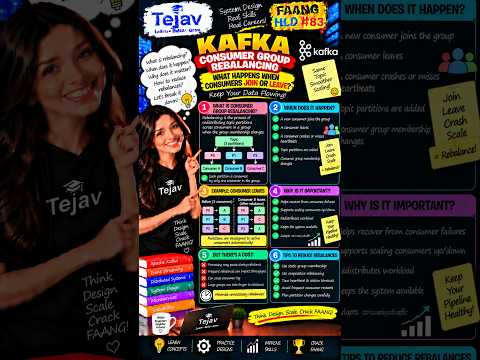
Kafka Consumer Group Rebalancing Explained
Kafka rebalances consumer groups to manage partition assignments effectively.