
I'm preparing for
🎛️ Narrow down IT & Codingsubject · level · topic▾
Results · 19 for “Database normalization”
← Front page✨ Smart search: matched by meaning, not just words

⚡ One HLD concept. 60 seconds. Interview ready
SQL vs NoSQL: Choosing the Right Database for Your Needs
The choice between SQL and NoSQL databases depends on your application's specific needs.

⚡ One HLD concept. 60 seconds. Interview ready
Understanding Database per Service in Microservices Architecture
Database per Service ensures each microservice owns its data, reducing dependencies.

⚡ One HLD concept. 60 seconds. Interview ready
Understanding Transactions and ACID Properties in Databases
Transactions ensure database operations are reliable using ACID properties.

⚡ One HLD concept. 60 seconds. Interview ready
Understanding Database Isolation Levels in Software Engineering
Database isolation levels determine how transactions interact and affect data consistency.
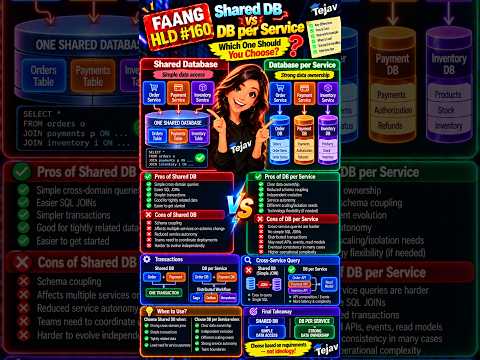
⚡ One HLD concept. 60 seconds. Interview ready
HLD: Shared DB vs Database per Service Trade-Offs
Choosing between a shared database and a database per service affects system design significantly.
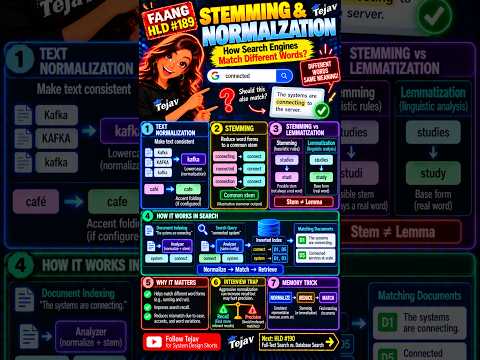
⚡ One HLD concept. 60 seconds. Interview ready
HLD: Stemming and Normalization in Search Engines
Stemming and normalization help search engines match various word forms for better results.

⚡ One HLD concept. 60 seconds. Interview ready
Understanding Sharding: How Databases Manage Large Data
Sharding splits databases into smaller parts to improve performance and scalability.

⚡ One HLD concept. 60 seconds. Interview ready
Identifying and Optimizing Database Bottlenecks
Database bottlenecks slow down performance, but identifying them helps optimize and scale effectively.

⚡ One HLD concept. 60 seconds. Interview ready
REST API Design: Building Scalable APIs for Real-World Use
REST API design focuses on creating clean, efficient, and scalable web services.

⚡ One HLD concept. 60 seconds. Interview ready
Database Replication: Scale and Survive Failures
Database replication helps keep data available and allows systems to handle more read requests.

⚡ One HLD concept. 60 seconds. Interview ready
Understanding Database Replication in High-Level Design
Database replication enhances data availability and read performance but has challenges like replication lag.

⚡ One HLD concept. 60 seconds. Interview ready
Read vs Write Scaling: How to Scale Databases
Scaling databases involves deciding whether to enhance read or write capabilities based on traffic patterns.

⚡ One HLD concept. 60 seconds. Interview ready
B-Tree Index: Efficient Database Navigation
B-Trees help databases find data quickly without scanning every row.

⚡ One HLD concept. 60 seconds. Interview ready
Understanding Scalable System Design in FAANG Companies
FAANG engineers use high-level design principles to create scalable systems.

⚡ One HLD concept. 60 seconds. Interview ready
Database Indexing: How to Make Queries Fast
Database indexing speeds up data retrieval by allowing quick lookups.

⚡ One HLD concept. 60 seconds. Interview ready
Understanding Load Balancers in System Design
Load balancers distribute traffic across multiple servers to enhance performance and reliability.

⚡ One HLD concept. 60 seconds. Interview ready
FAANG HLD 🔥 | Partition Pruning Explained — Scan Less, Query Faster! ⚡
Partition pruning helps databases skip unnecessary data scans, speeding up queries.

⚡ One HLD concept. 60 seconds. Interview ready
Understanding Cache Breakdown and Request Coalescing
Cache breakdowns can overwhelm databases, but request coalescing solves this issue.

⚡ One HLD concept. 60 seconds. Interview ready
Protobuf and Schema Evolution: Avoid Breaking Changes
Protobuf schema evolution requires careful changes to avoid breaking existing clients.