
I'm preparing for
Topic
system design
81 shorts across 1 course, in learning order
🎛️ Narrow downsubject · level · topic2▾
Results · 18 for “Cloud Storage Concepts”
← Front page✨ Smart search: matched by meaning, not just words

⚡ One HLD concept. 60 seconds. Interview ready
Understanding Data Residency in High-Level Design
Data residency is crucial for compliance with laws about where data can be stored.

⚡ One HLD concept. 60 seconds. Interview ready
Understanding CDN: How Cache Hits Improve Performance
A CDN speeds up web applications by caching content closer to users.

⚡ One HLD concept. 60 seconds. Interview ready
Distributed Caching: Why Spread It Out?
Distributed caching spreads data across multiple servers for better performance and reliability.

⚡ One HLD concept. 60 seconds. Interview ready
Understanding Cache Hits: Reducing Database Load
Caching helps applications respond faster by serving data from memory instead of hitting the database.

⚡ One HLD concept. 60 seconds. Interview ready
Understanding Database per Service in Microservices Architecture
Database per Service ensures each microservice owns its data, reducing dependencies.

⚡ One HLD concept. 60 seconds. Interview ready
Redis: Why Is It So Fast for High-Scale Systems?
Redis is a fast in-memory data store used for caching and low-latency applications.

⚡ One HLD concept. 60 seconds. Interview ready
Stream Processing Architecture: From Events to Real-Time Insights
Stream Processing Architecture helps turn incoming events into real-time insights efficiently.

⚡ One HLD concept. 60 seconds. Interview ready
Understanding Fault Domains in High-Level Design
Fault domains help prevent multiple servers from failing together in an architecture.

⚡ One HLD concept. 60 seconds. Interview ready
Understanding Elasticsearch Data Streams in HLD
Elasticsearch Data Streams simplify time-series data management with one name for many indices.

⚡ One HLD concept. 60 seconds. Interview ready
Disaster Recovery Across Regions: Can Your System Recover?
Disaster recovery ensures systems can restore services and data after major disruptions.

⚡ One HLD concept. 60 seconds. Interview ready
Choosing Service Boundaries in Microservices Architecture
Choosing the right boundaries for microservices is crucial for effective architecture.

⚡ One HLD concept. 60 seconds. Interview ready
Elasticsearch Data Streams vs. Time-Based Indices: Which to Choose?
Elasticsearch offers Data Streams for simplicity and Time-Based Indices for control in managing time-series data.
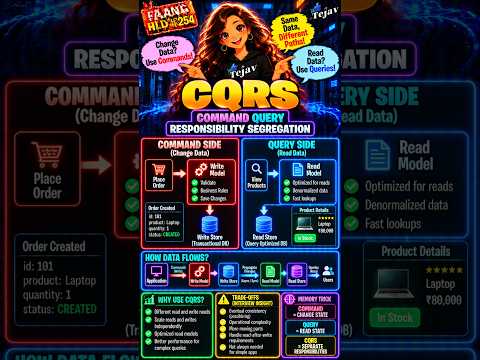
⚡ One HLD concept. 60 seconds. Interview ready
CQRS Explained: Commands vs Queries in System Design
CQRS separates how we change data from how we read data, improving scalability.

⚡ One HLD concept. 60 seconds. Interview ready
Understanding Availability vs Reliability in System Design
Availability is about access; reliability is about correct performance.

⚡ One HLD concept. 60 seconds. Interview ready
Understanding High Availability in System Design
High Availability ensures your application remains operational even during server failures.

⚡ One HLD concept. 60 seconds. Interview ready
Understanding Elasticsearch Cross-Cluster Replication (CCR)
Elasticsearch CCR allows real-time data replication for faster disaster recovery.

⚡ One HLD concept. 60 seconds. Interview ready
Understanding the Cache-Aside Pattern in System Design
The Cache-Aside Pattern speeds up data retrieval by using a cache to store frequently accessed data.

⚡ One HLD concept. 60 seconds. Interview ready
Understanding SPOF: Why Your App Can Go Down with Healthy Servers
A single component's failure can take down your entire application, even with redundancy.
🧠Related by meaning
Not tagged “system design”, but closely connected

