
I'm preparing for
Topic
system design
81 shorts across 1 course, in learning order
🎛️ Narrow downsubject · level · topic2▾
Results · 16 for “Data Lake Architecture”
← Front page✨ Smart search: matched by meaning, not just words

⚡ One HLD concept. 60 seconds. Interview ready
Stream Processing Architecture: From Events to Real-Time Insights
Stream Processing Architecture helps turn incoming events into real-time insights efficiently.

⚡ One HLD concept. 60 seconds. Interview ready
Understanding Data Residency in High-Level Design
Data residency is crucial for compliance with laws about where data can be stored.

⚡ One HLD concept. 60 seconds. Interview ready
Understanding Database per Service in Microservices Architecture
Database per Service ensures each microservice owns its data, reducing dependencies.

⚡ One HLD concept. 60 seconds. Interview ready
HLD: Batch vs Stream Processing in System Design
Batch processing collects data to process later, while stream processing handles data in real-time.

⚡ One HLD concept. 60 seconds. Interview ready
Understanding Elasticsearch Data Streams in HLD
Elasticsearch Data Streams simplify time-series data management with one name for many indices.

⚡ One HLD concept. 60 seconds. Interview ready
HLD: Late-Arriving Events - Drop, Update, or Replay?
Late-arriving events can be dropped, updated, or routed based on system needs.

⚡ One HLD concept. 60 seconds. Interview ready
Understanding Database Replication in High-Level Design
Database replication enhances data availability and read performance but has challenges like replication lag.
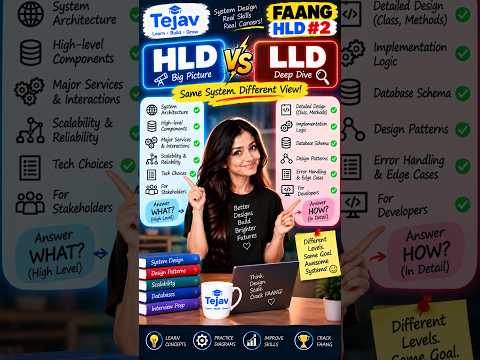
⚡ One HLD concept. 60 seconds. Interview ready
Understanding High-Level Design (HLD) and Low-Level Design (LLD)
HLD provides an overview of system architecture, while LLD details implementation specifics.

⚡ One HLD concept. 60 seconds. Interview ready
Identifying and Optimizing Database Bottlenecks
Database bottlenecks slow down performance, but identifying them helps optimize and scale effectively.

⚡ One HLD concept. 60 seconds. Interview ready
HLD: Full-Text Search vs Database Search with Elasticsearch
Choose Elasticsearch for complex text searches, but use databases for structured queries.

⚡ One HLD concept. 60 seconds. Interview ready
Elasticsearch Data Streams vs. Time-Based Indices: Which to Choose?
Elasticsearch offers Data Streams for simplicity and Time-Based Indices for control in managing time-series data.

⚡ One HLD concept. 60 seconds. Interview ready
Understanding Fault Domains in High-Level Design
Fault domains help prevent multiple servers from failing together in an architecture.

⚡ One HLD concept. 60 seconds. Interview ready
Understanding Elasticsearch Shards and Replicas in HLD
Elasticsearch uses shards for data distribution and replicas for redundancy.

⚡ One HLD concept. 60 seconds. Interview ready
Choosing a Distributed Lock: Redis vs Database vs ZooKeeper
Choosing the right distributed lock depends on your system's needs and existing tools.

⚡ One HLD concept. 60 seconds. Interview ready
HLD: Search Engine Architecture and Its Components
Search engines collect, index, retrieve, and rank documents to provide relevant results.

⚡ One HLD concept. 60 seconds. Interview ready
Redis: Why Is It So Fast for High-Scale Systems?
Redis is a fast in-memory data store used for caching and low-latency applications.
🧠Related by meaning
Not tagged “system design”, but closely connected

